City context
Udaipur is a city shaped by water and stone - seven interconnected lakes, the Aravalli hills rising on three sides, and the 460-year-old City Palace complex anchoring the old city against Lake Pichola. It is Rajasthan’s most prestigious destination, its most photographed, and its most internationally recognised - a city that exists in the global imagination as “the romantic city of India” in a way that no other Indian urban centre quite matches. Founded in 1559 by Maharana Udai Singh II after the fall of Chittorgarh to Akbar, the city has been the capital of the Mewar royal lineage for the subsequent 460 years, and the Mewar royal family still partially occupies the City Palace.
The 2011 Census recorded Udaipur’s population at 451,100. By 2026 the resident population is an estimated 750,000. What the census cannot capture is the transient population - tourists, destination-wedding attendees, pilgrims, business travellers - which at peak season can exceed 50,000 to 80,000 additional people staying in the city on any given night. Udaipur’s tourism statistics record over 3 million annual visitors, split roughly two-thirds domestic and one-third international, with European visitors especially prominent in the October-to-March window.
The city’s economic structure is unusual for a tier-C Indian city. Luxury tourism anchors one end - the Taj Lake Palace on Jag Niwas island, the Oberoi Udaivilas, the Leela Palace, the Chunda Palace, and dozens of heritage hotels generate per-night room rates that rival Mumbai’s top hotels. The destination-wedding economy extends this - Udaipur hosts among India’s most prestigious celebrity weddings, from Priyanka Chopra-Nick Jonas (2018) onward, driving a multi-billion-rupee annual ecosystem of decor, catering, florists, transport, and event management. The marble trade (supplied from the Rajsamand district 70 kilometres north) and Hindustan Zinc Limited’s corporate headquarters at Yashad Bhawan provide commercial and corporate employment. Mohanlal Sukhadia University and the newer IIM Udaipur anchor a student population of 80,000-plus. Small-scale handicrafts - miniature paintings (Pichwai style), silver jewellery, leather-bound notebooks, Rajasthani wooden toys - employ thousands in the narrower lanes around Hathi Pol, Bada Bazaar, and Bapu Bazaar.
Quick commerce story
Quick commerce came to Udaipur earlier than its 451,100 census population might have suggested. The cause was not size but per-capita income and tourism-driven consumer familiarity. By our estimates, Blinkit opened its first stores in late 2023, Zepto followed in the first half of 2024 - an unusually early tier-C entry for a platform with a metro-first posture, drawn by Udaipur’s above-state-average affordability - and Swiggy Instamart arrived later in 2024, leveraging Swiggy’s strong food-delivery base in the city (a robust Swiggy food market since 2019, buoyed by tourist in-hotel ordering and college students).
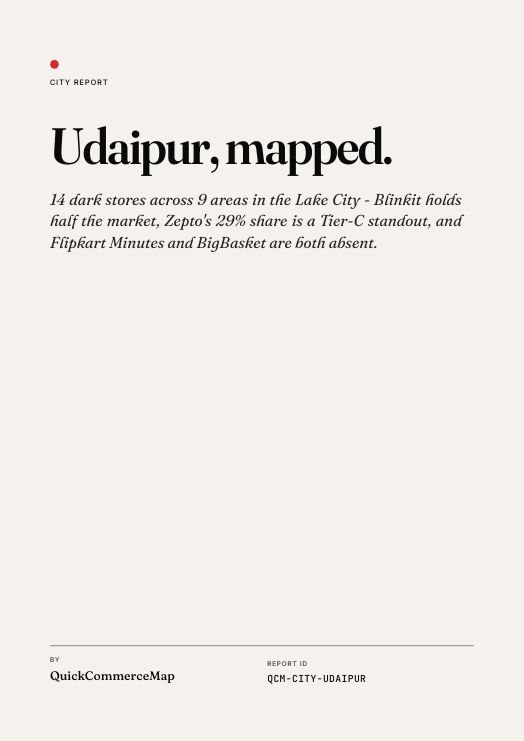
The July 2026 mapping records 14 dark stores across 9 areas: Blinkit 7, Zepto 4, Swiggy Instamart 3. Two things stand out against the wider dataset. First, the market structure - Blinkit 50%, Zepto 28.6%, Swiggy Instamart 21.4% - is closer to a balanced Tier-B distribution than the typical tier-C pattern of overwhelming single-platform dominance. Zepto’s 28.6% here runs 9 points above its 19.4% national share and roughly double the 14% it averages across Udaipur’s peer cities; the underlying driver is Udaipur’s upper-middle-class consumer base - Hindustan Zinc employees, IIM Udaipur faculty and families, wedding-industry entrepreneurs, and the hospitality-services upper tier - whose purchasing power and brand preferences align with Zepto’s premium positioning. Second, the two platforms our tracking added with the July 2026 data wave, Flipkart Minutes and BigBasket, have no presence in Udaipur at all. The Lake City is one of the few markets of its size where widening the lens from three platforms to five changed nothing on the map.
Spatially, the network resolves into nine mapped areas. Madhuban is the densest with 3 stores - two Swiggy Instamart and a Blinkit - followed by Bhuwana (a Blinkit and a Swiggy), Hiran Magri (a Blinkit and a Zepto), and Savina (a Blinkit and a Zepto) with 2 apiece. Five single-store areas complete the map: Malla Talai, Ganapati Nagar, and Pratap Nagar are Blinkit-only territory, while Shobhagpura and Panchwati are Zepto-only. The old city around the City Palace, Jagdish Temple, Hathi Pol, and the Bada Bazaar lanes - physically inaccessible to motorised delivery and culturally oriented toward traditional retail - has zero stores.
Platform deep-dive
Blinkit leads with 7 of the city’s 14 stores, an exact 50% share that runs 15.3 points above its 34.7% national footprint, spread one store per area across seven of the nine mapped areas - the widest coverage of any operator here. It is present in every multi-platform area (Madhuban, Bhuwana, Hiran Magri, Savina) and holds three areas alone: Malla Talai near the lakes’ western edge, Ganapati Nagar, and Pratap Nagar. That shape is the Zomato-owned platform’s standard playbook in northern and western tier-C markets - contest the dense middle-class cores, hold the periphery solo, and let brand recall compound.
Zepto is the market’s quiet overperformer. Its 4 stores and 28.6% share sit 9.2 points above its national average, in a city tier the platform generally treats as secondary. The placement is selective and consistent with its premium-basket positioning: contested positions in Hiran Magri and Savina, the planned middle-class residential belts, and sole-operator positions in Shobhagpura and Panchwati on the city’s newer, apartment-led north-eastern side. Swiggy Instamart, by contrast, runs the narrowest book - 3 stores in just two areas, with a two-store concentration in Madhuban and one in Bhuwana, and no exclusive territory anywhere. Its 21.4% share is only 3 points above its national norm, and the concentrated posture reads as a cross-sell play aimed at the neighbourhoods where its food-delivery order density is already proven, rather than a bid for citywide coverage.
The absences are as informative as the presences. Flipkart Minutes operates in 66 of Udaipur’s 100 closest peer cities and BigBasket in 53, yet neither has a single mapped store here - two white spaces that make Udaipur an outlier among its peers. Whether the constraint is the lake-and-hill delivery geography, the modest resident base beneath the tourist economy, or simply sequencing, our snapshot cannot say.
For residents, the practical result is a market with real, if partial, choice: four of the nine areas offer two platforms, five offer exactly one, and the next phase turns on whether either of the two absent national operators decides the Lake City’s economics are worth testing.
Underserved areas
Udaipur’s lake-and-hill geography creates natural delivery constraints that are not easily bridged. Pichola, Fateh Sagar, and Swaroop Sagar lakes interrupt the road grid. The Aravalli spurs ring the city on the west and south. The result is that each dark store’s effective 10-minute delivery radius covers significantly less geographic area than the radius would cover in a flat-grid city. A dark store in Hiran Magri cannot easily reach Bhupalpura across the lake; a Bhuwana store cannot reach Saheli Marg without crossing the Fateh Sagar corridor. This geometric constraint means that Udaipur’s 14 stores, while spatially well-distributed, serve less total addressable area than 14 stores in a comparable plains city like Ajmer or Kota would.
The trans-lake eastern quadrant is no longer entirely blank: Shobhagpura now carries a mapped Zepto store, the area’s only operator. But the adjoining belts - Bedla, Sapetia, Nimach Mata Road - remain outside the network despite steady residential growth, and one store against the quadrant’s expanding footprint is perimeter coverage rather than service. The Eklingji Road corridor north toward Nathdwara is similarly unserved; both zones are plausible deployment targets over the next 18-24 months if density matures.
The old city - the walled zone around the City Palace complex, Jagdish Chowk, Gangaur Ghat, Bagore ki Haveli, and the artisan lanes - will remain outside quick commerce coverage. The streets are too narrow, the demand is heritage-hotel-inbound rather than residential, and the population is a mix of traditional-retail-oriented families and short-stay hotel guests whose consumption patterns do not match QC.
Tourist and wedding-industry demand is the great unserved potential market. Three million annual visitors collectively generate enormous consumption of water, snacks, cosmetics, photo-shoot supplies, and last-minute personal items. None of this converts to QC because tourists purchase through hotels (minibars, concierge orders, in-house retail) or at the heritage-market shops (Hathi Pol, Lake Palace Road, Bada Bazaar). Wedding suppliers similarly operate through closed caterer and event-planner networks, not app-based channels. Unlocking even 10% of this tourist-and-wedding consumption would substantially change Udaipur’s QC economics, but no operator has yet developed a tourism-specific product.
Worker dimension
Udaipur’s 14 dark stores employ an estimated 112 to 210 workers, implying 17 to 63 new hires a month at industry-standard attrition - roughly 204 to 756 a year. Salary scales sit in the standard tier-C band: entry-level pickers earn ₹11,000 to ₹16,000 per month, store incharges ₹16,000 to ₹22,000, store managers ₹25,000 to ₹45,000. These wages are competitive locally - Udaipur’s cost of living is moderate, and the alternative local employment (marble industry labour, hotel service staff, handicrafts workshops) typically offers lower wages or less stable hours.
Labour supply is heterogeneous. Udaipur draws workers from the surrounding tribal districts of Dungarpur, Banswara, and Pratapgarh, as well as from the more urbanised Chittorgarh and Rajsamand districts. The city’s tribal-rural hinterland provides a younger-skewing, physically capable workforce accustomed to manual labour. Retention is moderate - the pull of NCR migration exists but is weaker than in UP or Bihar origin cities, because Udaipur offers a relatively high quality-of-life at local wages, and tribal-origin workers typically have stronger family-network reasons to stay in Rajasthan.
Seasonal demand patterns add a wrinkle. Udaipur’s tourism peak (October-March) drives elevated QC order volumes - both from visiting tourists (where they can be captured) and from the hospitality-industry workforce whose own consumption rises with employment. Monsoon season (July-September) sees both tourist and local demand compress. Dark store operators here manage workforce flex more actively than in flatter-demand cities.
Consumer dimension
Udaipur’s affordabilityIndex of 64 places it above the tier-C median. The addressable QC population is an estimated 150,000 to 200,000 - concentrated in Hiran Magri, the Bhuwana-Madhuban belt, Savina, and the IIM Udaipur campus-vicinity belt of Goverdhan Vilas and Balicha. Hindustan Zinc Limited (Vedanta group) employee households form a stable, brand-aware corporate consumer segment. IIM Udaipur’s student and faculty population is highly app-native and convenience-oriented. Private-school-educated, dual-income professional households across the city’s planned residential zones round out the base. Four of the nine mapped areas - Madhuban, Bhuwana, Hiran Magri, and Savina - give these households a choice of two platforms; the other five offer exactly one.
The wedding economy creates an interesting secondary consumer pattern. Wedding-industry entrepreneurs - photographers, florists, caterers, event managers, venue operators - are small-business households with irregular but often large income bursts. During the October-January wedding peak, these households increase QC usage significantly; during the April-June low season, usage drops. Platforms with flexible customer-retention mechanics (Swiggy Instamart’s Swiggy One subscription, Blinkit’s intelligent notifications) perform better with this segment.
Traditional retail competition is fierce. Bada Bazaar, Bapu Bazaar, and the old-city markets have generations-old wholesale-retail chains with price advantages on staples that quick commerce cannot match. Premium grocery stores like Reliance Fresh and D-Mart (newer, on Sukher Road) occupy the middle positioning between kirana and QC. The QC value proposition in Udaipur is therefore positioned narrowly on time-value: households willing to pay the 5-15% pricing premium specifically for the elimination of the drive-to-D-Mart round-trip, or for the ability to order at 10 PM when traditional retail is closed.
Industry context
Within Rajasthan, the July 2026 mapping places Udaipur’s 14 stores ahead of Kota’s 12 and double Jodhpur’s 7 - a striking result given that Jodhpur’s population is roughly twice Udaipur’s. At approximately 19 stores per million residents, Udaipur sits far above the 3-per-million national average, a density that reflects both the city’s compact addressable core and its above-median purchasing power. Among similar-tier peers nationally, the count is right in the band: Secunderabad records 14 mapped stores, Vasai Virar 15, Gorakhpur 15 - though each of those markets includes at least some of the newer platforms, where Udaipur’s field remains the original three.
The more instructive comparison is with other heritage-tourism cities. Jaisalmer and Pushkar are too small for any QC deployment, and Jaipur operates at an entirely different scale as a Tier-A heritage metropolis. Udaipur’s 14 stores represent the practical formula for a heritage tourism-economy city that also has genuine upper-middle-class residential density: resident demand anchors QC, tourist demand is unaddressable bonus.
The growth trajectory now has three variables rather than two. First, whether residential development in the trans-lake eastern belt (where Zepto’s Shobhagpura store is the lone outpost) and the Eklingji Road corridor accelerates to densities that support additional stores. Second, whether any operator develops a tourism-specific product - perhaps in partnership with heritage hotel groups - that can finally capture the otherwise-unaddressable tourist consumption. Third, and newest, whether Flipkart Minutes or BigBasket enters at all: both operate in half or more of Udaipur’s peer cities, and either arrival would redraw a competitive map that today divides cleanly among three incumbents. Our snapshot cannot predict any of the three; it can only note that a 14-store, three-platform market with two well-capitalised national absentees is unlikely to be the end state.
Methodology
This report draws on the QuickCommerceMap July 2026 dataset of 5,625 dark stores across 408 Indian cities, compiled from publicly observable store-locator information published by Blinkit, Zepto, Swiggy Instamart, Flipkart Minutes, and BigBasket. Coverage of Flipkart Minutes and BigBasket begins with this July 2026 data wave; neither platform has a mapped presence in Udaipur. All store locations are approximate (to roughly 100 metres), and the dataset is a point-in-time snapshot - platform networks change week to week. For Udaipur, 14 stores were identified across 9 distinct areas.
Store coordinates were reverse-geocoded using a three-API fallback chain - Ola Maps (primary), Mappls (secondary), and Nominatim (tertiary) - to derive locality names and area assignments. Platform entry timelines are editorial estimates and should be read as approximate. Demographic data derives from Census of India 2011, projected to 2026 using WorldPopulationReview methodology. Tourism statistics draw on Rajasthan Tourism Department annual reports. Economic context uses MoSPI state-level NSDP figures, with Hindustan Zinc Limited’s disclosed workforce and Vedanta group reports supplementing local employment estimates. Lake-geography delivery-constraint observations derive from mapping store locations against Udaipur’s lake boundaries using the QuickCommerceMap coordinate dataset. Worker and hire estimates apply the standard QuickCommerceMap methodology of 8-15 workers per store and 15-30% monthly attrition, cross-referenced with QuickCommerceJobs salary data for Rajasthan tier-C markets. All indices (incomeIndex, smartphoneIndex, apartmentIndex, affordabilityIndex) are editorial judgements on a 0-100 scale, documented in the expansion enrichment panel.