City context
Trivandrum - formally Thiruvananthapuram, meaning “City of Lord Ananta” in Sanskrit-via-Malayalam - is Kerala’s state capital and the southernmost major city on India’s west coast. The name’s literal meaning refers to Lord Vishnu in his Ananta form, the coiled serpent upon whose body the deity reclines at the city’s spiritual centre: the Sree Padmanabhaswamy Temple. That temple - managed directly by the royal family of Travancore - became globally famous in 2011 when a Supreme Court-ordered audit of its vaults revealed gold, silver, and jewel reserves valued at over $22 billion, making it the wealthiest religious institution in the world by measured treasury value.
The city’s 2011 Census population was 957,730 with an urban agglomeration of 1.68 million; by 2026 the UA is an estimated 1.75 million. The decadal growth has been slow - just 4.5% over 2001-2011, and roughly flat since - characteristic of Kerala as a whole. Kerala has had below-replacement fertility (total fertility rate around 1.7) for over two decades, significant out-migration to the Gulf, and a demographic profile that skews older than North Indian cities. Female literacy in Trivandrum is 91.72% - among the highest of any Indian city - and the sex ratio of 1,047 females per 1,000 males is one of the highest nationally, reflecting Kerala’s exceptional social development metrics and the male-skewed pattern of Gulf migration.
The city’s economic base is distinctive. Government employment anchors the core - Trivandrum is the seat of the Kerala Legislative Assembly, the state Secretariat, the Governor’s office (Raj Bhavan), and all state-level directorates. An estimated 150,000 to 200,000 people are employed directly by the state government and PSUs. Layered on top is Technopark, one of Asia’s largest IT parks, located at Kazhakkoottam about 15 kilometres north of the city centre. Founded in 1990, Technopark now occupies over 760 acres and hosts more than 500 companies - including TCS, Infosys, UST Global, Oracle, EY, and hundreds of smaller firms - employing an estimated 80,000-plus IT professionals. VSSC-ISRO (Vikram Sarabhai Space Centre), India’s principal rocket-propulsion R&D institute, is headquartered at Thumba nearby, employing around 15,000 scientists and engineers. Healthcare, anchored by Sree Chitra Tirunal Institute, KIMSHEALTH, and Ananthapuri, makes the city a regional medical hub. Tourism - Kovalam beach, Ponmudi, Padmanabhaswamy Temple - adds a moderate tail economy.
Kerala’s labour environment is fundamentally different from any other major Indian state. Strong trade-union culture, rigorous minimum-wage enforcement, limitations on contract labour, and cultural expectations of formal employment mean that businesses operate with higher labour cost structures than equivalents in Bangalore, Chennai, or Mumbai. This environment has directly shaped Trivandrum’s quick commerce story - in ways that have few parallels elsewhere in India.
Quick commerce story
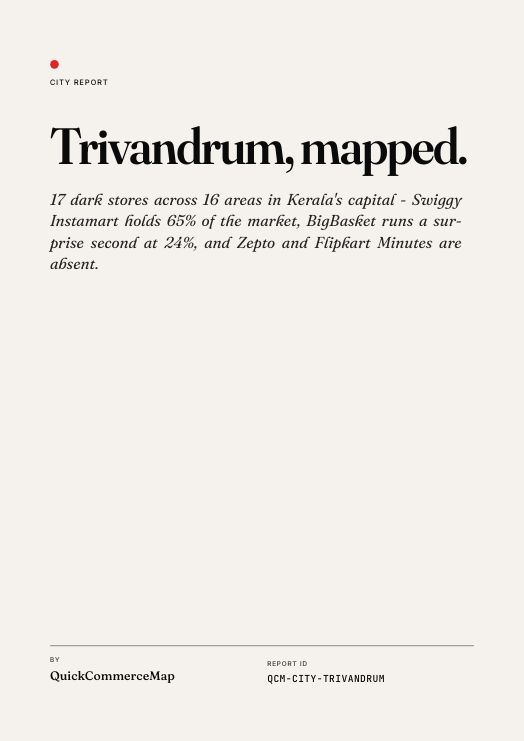
Trivandrum’s quick commerce story remains among the most unusual in the QuickCommerceMap dataset, even after the July 2026 data wave widened our tracking from three platforms to five. The city’s mapped network stands at 17 dark stores across 16 areas: Swiggy Instamart 11 (64.7%), BigBasket 4 (23.5%), Blinkit 2 (11.8%). Zepto holds 0% - zero presence, consistent with its broader Kerala abstention - and Flipkart Minutes, present in two-thirds of Trivandrum’s peer cities, is likewise absent from our mapping. Notably, the three platforms we tracked through March 2026 account for exactly the same 13 stores they did then; the move from 13 to 17 comes entirely from BigBasket entering our field of view. What read as an 85% Swiggy monopoly under the three-platform lens resolves, seen whole, into a 65% dominance with a Tata-owned second operator our earlier snapshots simply could not see.
The dominance itself is not an accident of timing or data capture - it is the direct output of three structural forces. First, Swiggy had deep pre-existing infrastructure in Trivandrum. The Swiggy food-delivery platform has been operating in Kerala since 2018 and has built dense local relationships with restaurants, delivery-partner networks, and - critically - compliant labour frameworks aligned with Kerala’s stringent regulatory environment. When Swiggy Instamart entered Trivandrum - by our estimate in late 2023 - it could leverage this entire operational stack: hiring through established networks, operating delivery fleets that already complied with Kerala labour law, and cross-selling to the existing Swiggy food-delivery customer base.
Second, Blinkit’s entry faced structural friction. Blinkit is owned by Zomato, which has its own Kerala food-delivery presence, but Zomato’s Kerala footprint has historically been smaller than Swiggy’s. More importantly, Blinkit’s dark store operating model - which leans on contract labour and high-turnover workforces in most Indian cities - does not translate cleanly into Kerala’s formal-employment labour environment. Compliance costs per dark store are substantially higher in Kerala than in, say, Bangalore or Mumbai, compressing unit economics. Blinkit has responded with a minimum-viable-presence posture: two stores, one mapped in the central Thiruvananthapuram core and one in Kuravankonam, on the stretch between Kowdiar and Ambalamukku that houses much of the city’s professional elite. This is not a competitive push - it is a foothold.
Third, Zepto has chosen to skip Kerala entirely. Zepto’s aggressive 10-minute-delivery model requires even tighter dark store unit economics than Blinkit’s, and Zepto’s relative lack of existing Kerala operations gives it no cost-advantage pathway. Combined with Kerala’s strong traditional retail (including cooperative-movement retail chains like Consumerfed and Kerala State Civil Supplies Corporation), Zepto appears to have concluded that the market is unfavourable at premium-service cost structures. Flipkart Minutes’ absence is harder to read - the platform operates in 66 of Trivandrum’s 100 closest peer cities - but the same labour-cost arithmetic that keeps Blinkit at two stores plausibly applies to any operator built on contract-heavy logistics.
Spatially, Swiggy’s 11 stores spread one per area across eleven localities: Pettah and Palayam in the commercial core; Poojapura, Thirumala, and Pappanamcode across the south-eastern residential belt; Peroorkada and Ambalamukku in the north-east; Murinjapalam by the Medical College belt; Vadakkumbhagam toward the old city; and Kallampally and Kulathoor on the northern side toward the Technopark corridor. BigBasket’s four stores hold Kowdiar, Pangappara, and the Medical College area as sole operator, and share Kulathoor with Swiggy Instamart - the only area in the entire city where two platforms compete. Blinkit’s two stores round out the map in the central city and Kuravankonam.
Platform deep-dive
Swiggy Instamart is the market. Its 11 of 17 stores translate to a 64.7% share, more than 46 points above its 18.5% national footprint and roughly triple the 22% it averages across Trivandrum’s peer cities. The shape of the network is as telling as its size: one store per area across 11 areas, 10 of them - Poojapura, Murinjapalam, Ambalamukku, Thirumala, Pettah, Palayam, Pappanamcode, Kallampally, Peroorkada, and Vadakkumbhagam - held with no competitor present. This is a breadth-first design, the footprint of a platform serving the whole city off its food-delivery rails rather than contesting a rival block by block. Nobody else in the market has forced it to double up anywhere.
BigBasket is the July mapping’s revelation. The Tata-owned grocer holds 4 stores (23.5%), double its 11.8% national share, and is sole operator in Kowdiar - the city’s most elite residential address - as well as Pangappara and the Medical College belt, while contesting Kulathoor alongside Swiggy. Its coverage in our dataset begins with the July 2026 wave, so we make no claim about when these stores arrived; what the placement shows is a deliberate skim of the city’s highest-income and most staples-oriented catchments. BigBasket’s scheduled-delivery heritage and conservative, staples-heavy assortment are arguably the best cultural fit among the five national platforms for a Kerala consumer base that still routes most grocery spend through cooperatives and trusted neighbourhood retail.
Blinkit, the national leader with 34.7% share, holds just 11.8% here - 2 stores against peer-city averages near 40%, one of the weakest relative positions the platform occupies anywhere in our dataset for a market of this size. Its two exclusive areas, the central Thiruvananthapuram core and Kuravankonam, target the same professional households Swiggy and BigBasket court, but at token depth. Zepto and Flipkart Minutes complete the picture by omission: zero stores each, despite operating in 57% and 66% of comparable cities respectively.
For residents, the sum is coverage without competition: 15 of 16 mapped areas - 94%, among the highest exclusivity rates we track - are single-operator territory, and only Kulathoor households can choose between two apps. The market’s next phase turns on whether either absentee, or Blinkit itself, decides Kerala’s labour-cost structure is worth solving at scale; until then, Swiggy Instamart’s position looks structurally secure.
Underserved areas
In the strict sense of “demand unmet by current coverage,” Trivandrum’s underserved zones are modest. The 17-store network across the residential upper-middle-class belts and the Technopark-side corridor covers most of the addressable QC demand. The coastal belt (Kovalam, Vizhinjam), the southern residential extensions (Balaramapuram, Neyyattinkara peri-urban), and the northern peri-urban zones beyond Kazhakkoottam remain outside the QC network - but these areas’ density and income profiles make them marginal candidates for dark store deployment in any case.
The more interesting “underservice” is competitive rather than geographic. Fifteen of the city’s sixteen mapped areas have exactly one operator. Households in Poojapura or Peroorkada have Swiggy Instamart or nothing; Kowdiar households have BigBasket or nothing; there is no Zepto option anywhere in the city, and only Kulathoor offers a genuine two-platform choice. The absence of head-to-head competition means that QC pricing in Trivandrum is set by each platform’s positioning within its own territory rather than by rivalry. Whether this territorial carve-up is “underservice” depends on one’s frame - consumers receive consistent service from a dominant platform but without the discounting, loyalty-program aggression, and assortment competition that drives value in genuinely multi-platform cities.
The tourism belt - Kovalam, the beach-hotel zone, the Padmanabhaswamy Temple pilgrim-adjacent areas - remains unaddressable by QC in the same way as other tourism economies. Hotels service guest needs through in-house channels; pilgrims consume through temple-adjacent traditional retail; backpacker tourists in Kovalam rely on beach-vendor and guesthouse-adjacent purchases. None of this converts to QC.
Worker dimension
Trivandrum’s 17 dark stores employ an estimated 136 to 255 workers across picker, delivery, and store-management roles - implying 20 to 77 new hires a month at industry-standard attrition, or roughly 240 to 924 hires a year. The employment structure differs from the Indian norm. Kerala’s minimum-wage regulations, strong union presence, and cultural expectations of formal employment mean that dark store work here comes with more formal benefits structures than in most tier-C markets. Entry-level pickers earn ₹11,000 to ₹16,000 per month, store incharges ₹16,000 to ₹22,000, store managers ₹25,000 to ₹45,000. Provident Fund and ESI coverage is the default, not the exception.
Labour supply has a distinctive texture. Kerala’s educational attainment is extraordinarily high, with most young adults holding at least a secondary-school certificate. This means dark store workers are often over-qualified for manual picker roles by comparison to the national labour market. The flip side: Kerala’s overall young-adult unemployment rate is elevated, and the Gulf-migration pathway that has historically absorbed Kerala’s young males has narrowed since 2020 as oil-economy countries diversified and COVID-era repatriations created domestic labour surpluses. Dark store roles in Trivandrum are therefore sought-after relative to other tier-C cities - retention is higher, turnover is lower.
The structural cost differential this creates is the reason Blinkit has stayed shallow and Zepto has stayed out. A Trivandrum dark store costs materially more to operate than a Coimbatore or Chennai equivalent, and only Swiggy Instamart’s scale and cross-sell advantages - and perhaps BigBasket’s slower, scheduled-delivery-inflected model - have made the economics workable.
Consumer dimension
Trivandrum’s affordabilityIndex of 70 places it firmly at the top of the Tier-C range, approaching Tier-B levels. Kerala’s human development metrics (HDI ranks among the highest in India), the state government’s large formal-employment base, Technopark’s IT-professional salaries, and Gulf-remittance inflows together support a large and brand-aware consumer base. The addressable QC population is an estimated 300,000 to 400,000 residents - roughly a quarter of the UA - concentrated in Kowdiar, Pattom, Sasthamangalam, Vellayambalam, Vazhuthacaud, and the Kazhakkoottam-Technopark corridor.
Consumer behaviour in Trivandrum is distinctive in several ways. Digital literacy is extraordinarily high - Kerala consistently ranks first or second in India on smartphone penetration, digital-payment adoption, and internet usage. App-based grocery ordering faces less behavioural friction here than in comparable-population cities in North or Central India. At the same time, the state’s strong cooperative-movement retail (Consumerfed, Kerala State Civil Supplies Corporation), dense traditional retail, and culturally-rooted weekly-market shopping patterns compete effectively for household grocery budgets.
The Technopark IT-professional segment is the most aggressive QC consumer. Young professionals working late-hour shifts, living in apartment-dense zones around Kazhakkoottam, Sreekaryam, and Pangappara, use quick commerce for late-evening grocery top-ups, office snack supplies, and weekend-indulgence orders - and this is the one corridor where the market offers a choice, with Swiggy stores in Kulathoor and Kallampally and BigBasket in Kulathoor and Pangappara. This segment’s order frequency is 3-5 times per week per active household - comparable to Bangalore’s Koramangala or Whitefield IT professional pattern.
Gulf-remittance households in the Thycaud-Pettah-East Fort inner-city zone and in the newer residential extensions represent a different consumer profile - upper-middle-class purchasing power, but more traditional retail-channel preferences. QC here captures supplementary demand; the primary grocery relationship remains with trusted cooperatives and neighbourhood stores. BigBasket’s Kowdiar and Medical College placements read as a direct bid for exactly these staples-first households.
Industry context
Within Kerala, the July 2026 mapping puts Trivandrum’s 17 stores ahead of its same-state benchmark peers - Kalamassery, in the Kochi metropolitan belt, records 11, and Kozhikode 9. At roughly 10 stores per million residents, Trivandrum also sits well above the 3-per-million national average. Against similar-tier peers outside the state the count is unremarkable - Dombivli has 16 mapped stores, Bareilly 16, Kharar 19 - but the market structure is anything but: every one of those peer markets is Blinkit-led, while Trivandrum is the Swiggy-led exception in the set.
The platform-share comparison remains the city’s defining statistic. Swiggy Instamart’s 64.7% share stands 46.2 points above its 18.5% national average and roughly triple its 22% peer-city norm. The July revision from “85% Swiggy” to “65% Swiggy” is a change in visibility, not in Swiggy’s position - the three originally tracked platforms hold the same 13 stores they held in March, and the four additional stores now on the map all belong to BigBasket, whose coverage begins with this data wave. The honest reading is that Trivandrum was never quite the one-platform city our earlier snapshots suggested; it is a two-platform city in which the second platform was invisible to us, and in which the nominal national leader is a bystander.
The 24-month trajectory depends on whether any of the absentees or under-investors move. Blinkit, if it chose to absorb Kerala’s labour-cost structure, could plausibly scale from 2 stores toward credible competition; Flipkart Minutes has the peer-city precedent but no observed presence; Zepto’s entry looks least likely in the near term. BigBasket’s staples positioning gives it room to deepen in the very neighbourhoods where Kerala’s consumption culture is strongest. Absent such moves, the likeliest path is incremental: Swiggy Instamart consolidating its one-store-per-area lattice as Sreekaryam, Kulathoor, and the Technopark extension mature, and Trivandrum remaining one of the most lopsided - and most stable - platform markets in the country.
Methodology
This report draws on the QuickCommerceMap July 2026 dataset of 5,625 dark stores across 408 Indian cities, compiled from publicly observable store-locator information published by Blinkit, Zepto, Swiggy Instamart, Flipkart Minutes, and BigBasket. Coverage of Flipkart Minutes and BigBasket begins with this July 2026 data wave, so comparisons with our earlier three-platform snapshots are noted explicitly where they appear. All store locations are approximate (to roughly 100 metres), and the dataset is a point-in-time snapshot - platform networks change week to week. For Trivandrum, 17 stores were identified across 16 distinct areas.
Store coordinates were reverse-geocoded using a three-API fallback chain - Ola Maps (primary), Mappls (secondary), and Nominatim (tertiary) - to derive locality names and area assignments. Demographic data derives from Census of India 2011, projected to 2026 using WorldPopulationReview methodology. Technopark statistics and employment data draw on the Technopark Thiruvananthapuram annual reports. Kerala labour-law context uses Kerala Government Labour Department notifications and state minimum-wage schedules. Economic context uses MoSPI Kerala NSDP figures. Worker and hire estimates apply the standard QuickCommerceMap methodology of 8-15 workers per store and 15-30% monthly attrition, cross-referenced with QuickCommerceJobs salary data for Kerala markets. All indices (incomeIndex, smartphoneIndex, apartmentIndex, affordabilityIndex) are editorial judgements on a 0-100 scale, documented in the expansion enrichment panel.