City context
Salem is a city defined by a single state-sector employer, a dominant agricultural commodity, and its position at the centre of Tamil Nadu’s inland Kongunadu economic belt. Salem Steel Plant - SAIL’s specialised stainless steel facility, established in 1984 - is India’s largest producer of cold-rolled stainless steel coils and the city’s industrial anchor. The Salem district is one of India’s leading mango-producing regions, supplying Ramdev, MTR, Priya, and regional food-processing units. The Kongunadu textile corridor passes through the city, with thousands of power-loom units operating in Suramangalam, Ammapet, and the Salem-Attur belt. And Yercaud - a modest hill station in the Shevaroy Hills, 32 kilometres away - adds a supplementary weekend-tourism economy. These four pillars together shape Salem’s economy, and each pillar shapes a different part of the consumer base.
The 2011 Census recorded Salem’s population at 831,038 with the urban agglomeration at 919,150. By 2026 the resident population is an estimated 1.1 million, making Salem Tamil Nadu’s fifth-largest city after Chennai, Coimbatore, Madurai, and Tiruchirappalli. Growth has been steady rather than dynamic - well below Coimbatore’s and Tiruppur’s rates - reflecting constrained scale-up at Salem Steel Plant, out-migration of young professionals to Coimbatore and Bangalore, and the dominance of traditional trader-retail channels that slow urban consumer-economy diversification.
The city’s geography is distinctive. Salem sits in a basin surrounded by the Shevaroy, Kanjamalai, and Jarugumalai hills. The Salem Steel Plant township is a self-contained planned community several kilometres from the commercial core, with its own schools, hospital, shopping centre, and kirana network. The historic commercial core - Fairlands, Hasthampatti, Shevapet, Ammapet - has the typical Tamil walled-market density with 2-to-4-metre lanes, permanent vendor occupancy, and a multi-generational kirana ecosystem. Suramangalam and Ayodhyapattinam are the modern residential expansions, still growing but at a slower pace than equivalent Coimbatore or Erode expansions. This fragmented urban structure - township here, commercial core there, residential expansion elsewhere - shapes the entire QC addressable market.
Quick commerce story
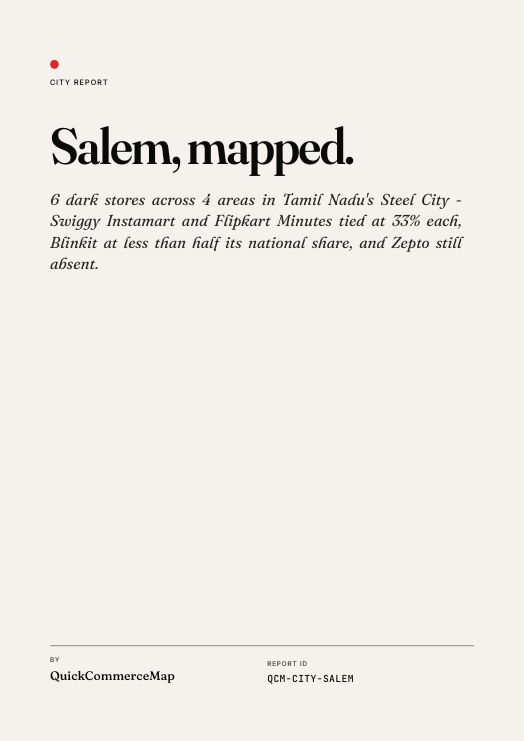
Salem came to quick commerce in late 2024, following the Tamil Nadu pattern of Swiggy-led entry. Swiggy Instamart’s first Salem stores opened, by our estimate, in the fourth quarter of 2024, leveraging a food-delivery presence dating to 2019; Blinkit’s single store followed in 2025, and Zepto has not entered. That much survives from our March 2026 snapshot. What changes with the July 2026 data wave is the width of the lens: our tracking now covers Blinkit, Zepto, Swiggy Instamart, Flipkart Minutes and BigBasket, and the two newly tracked operators - Flipkart Minutes and BigBasket - turn out to be running three stores between them. The July mapping records 6 dark stores across 4 areas: Swiggy Instamart 2 (33.3%), Flipkart Minutes 2 (33.3%), Blinkit 1 (16.7%), BigBasket 1 (16.7%), and Zepto 0. The original three platforms hold exactly the 3 stores they held in March; the doubling of the headline count is a fact about our coverage, not about a burst of expansion.
The revised arithmetic changes Salem’s standing. Six stores against 1.1 million residents works out to roughly 5 stores per million - above the national average of 3, a figure diluted by hundreds of thinly covered cities, but still thin for Tamil Nadu’s fifth-largest city and behind similar-size peers such as Tiruchirappalli, which holds 8 stores on a slightly smaller population. Salem is not quite the outright under-server our three-platform snapshot made it look, but the structural story that produced that impression still holds.
Two factors explain the thinness. First, the Salem Steel Plant township is a partial QC-substitute. The township’s employee households - the single most QC-ready demographic in the city - can walk to the township’s internal shopping centre and kirana network for most daily needs. This means the segment most likely to drive QC adoption in other industrial cities has a native retail alternative in Salem that reduces incremental QC demand. Second, the Fairlands-Hasthampatti-Shevapet commercial core has the typical Tamil walled-market structure that limits motorised delivery access, combined with a trader-retail-loyalty culture that resists app-based replacement. The platforms’ answer, visible in the July map, has been to site at the core’s edge rather than inside it.
Spatially, the market’s centre of gravity is Shevapet, where 3 of the 6 stores cluster - a Blinkit, a Swiggy Instamart, and a Flipkart Minutes - making it the only area where residents can compare platforms. Swiggy Instamart holds Alagapuram Periyaputhur alone; Flipkart Minutes holds Narasothipatti alone; BigBasket holds Meyyanur alone. Nothing operates in Ammapet (the textile-weaver core), the Salem Steel Plant township, Ayodhyapattinam, or the Yercaud Road extension. The effective addressable market for QC therefore remains narrower than the city’s population would suggest - perhaps 180,000 to 260,000 people across the non-township professional and young-family segments.
Platform deep-dive
Swiggy Instamart shares the lead with 2 of Salem’s 6 stores, a 33.3% share nearly 15 points above its 18.5% national footprint. It is the only one of the original three platforms behaving like a home team - one store in the contested Shevapet cluster and one holding Alagapuram Periyaputhur alone - and the position fits the wider Tamil Nadu pattern, in which the parent Swiggy app’s long-established food-delivery density gives Instamart a cross-sell base its rivals lack.
Flipkart Minutes, whose coverage begins with our July 2026 data wave, matches it store for store: 2 stores, 33.3%, nearly 18 points above the platform’s 15.6% national share, making Salem one of its stronger relative markets in our dataset - its peer-city average share is roughly 14%. One store contests Shevapet; the other holds Narasothipatti alone. As industry context, Flipkart launched Minutes in 2024 on the back of its national e-commerce logistics network, and a strong showing at an inland Tamil Nadu freight node - Salem Junction sits on the Bangalore-Salem-Chennai line - is consistent with an operator that expands where its parent’s supply chain is already thick.
BigBasket’s single Meyyanur store (16.7%, about five points above its 11.8% national share) is a characteristic play for the Tata-owned grocer: one exclusive residential catchment and a staples-heavy, scheduled-delivery heritage that maps well onto Salem’s trader-family and steel-plant household baskets. Blinkit is the striking laggard - one Shevapet store, a 16.7% share that runs 18 points below its 34.7% national average, no exclusive territory, and one of its weakest relative positions among Salem’s peer cities, where it averages roughly 40%. Zepto is absent altogether despite operating in 57% of comparable cities, extending its familiar thin coverage of Tamil Nadu’s interior.
The result is a market where the national league table is turned upside down: the two challengers tie for the lead, the national number one runs a single store, and three of four areas have exactly one operator. For Salem’s residents, platform competition exists only in Shevapet - everywhere else, quick commerce means whichever app happens to have planted the local flag.
Emerging expansion opportunity
Salem’s expansion thesis divides into three distinct questions, each with a different probability.
The first question is whether a platform commits to the Salem Steel Plant township. With thousands of employee households on steady formal-sector wages and planned housing density, the township is structurally attractive - the reason it has not been served is its internal retail substitute, not the underlying demographic fit. A dedicated store inside or immediately adjacent to the township could reasonably capture a meaningful share of the township’s convenience-grocery demand, particularly for the branded and specific-demand SKUs the small township shops do not stock. Any of the four operators present could make this move; for Blinkit it would double as the network reset its single-store position needs.
The second question is whether Zepto breaks its Tamil Nadu under-presence, and Salem is a representative test. The city’s demographics - a 1.1 million population, concentrated trader-family wealth, a SAIL-township professional base, and the Fairlands-Ayodhyapattinam apartment expansion - map to markets where Zepto has succeeded in western India. Zepto operates in 57 of 100 cities comparable to Salem in our dataset, so the absence reads as a state-level posture rather than a Salem-specific verdict. The downside risk of a single probe store is modest, and the option value is significant: a store that clears contribution-margin targets would give Zepto a foothold in interior Tamil Nadu that it currently lacks.
The third question is geographic extension by the platforms already present. For Swiggy Instamart, reaching toward Ayodhyapattinam and the Yercaud Road weekend corridor is the natural scaling pattern. For Flipkart Minutes and BigBasket, the July map already shows the periphery play - Narasothipatti and Meyyanur are exclusive positions the original three never took, and the question is whether they deepen them. For Blinkit, the question is simpler and harder: whether one store in Shevapet is a probe or a posture.
The ceiling for Salem is more binding than its population suggests. The township retail substitute, the walled-commercial-core structure, and Kongunadu trader-retail loyalty together cap the effective QC addressable market at perhaps 250,000 to 300,000 people. That still leaves headroom above the current 6 stores, but it argues for a market that deepens in single-store steps rather than in waves.
Worker dimension
Salem’s 6 dark stores employ an estimated 48 to 90 workers, and maintaining that workforce at industry attrition rates of 15-30% a month implies roughly 7 to 27 new hires every month. Labour supply is abundant - the steel plant’s contractor workforce rotation, the power-loom sector’s continuing consolidation, the SIPCOT engineering units, and the agricultural seasonal workforce all release workers seeking formal employment. Salem’s Industrial Training Institute (ITI Salem) and the skill-development programmes run by SAIL create a labour pool with basic inventory-handling and digital-literacy skills.
Entry-level pickers in Salem earn ₹11,000-16,000 per month, store incharges ₹16,000-22,000, and store managers ₹25,000-45,000, with delivery partners typically in the ₹12,000-22,000 band - standard rates for Tamil Nadu markets of this size. The cost-of-living counterweight is moderate: shared-room rents in Fairlands and Hasthampatti-adjacent localities run ₹2,500 to ₹5,000, and Tamil Nadu’s meal-plate economy keeps food costs predictable. A typical Salem dark store worker’s purchasing power is close to face value - neither a materially better nor a materially worse deal than comparable TN cities.
Retention is a moderate challenge. Workers who develop skills at a dark store face offers from Coimbatore (165 kilometres, 15-20 per cent wage premium), Bangalore (220 kilometres, 40-60 per cent premium), and Chennai (340 kilometres, 30-50 per cent premium). Salem’s advantage is proximity - a worker who moves away can still visit home on a 3- to 4-hour bus, which reduces the cultural cost of out-migration. The counterweight is the strong Tamil-family local-preference culture; many workers remain in Salem despite wage differentials.
Consumer dimension
Salem’s affordability index of 52 places it at our small-market median. The nominal addressable QC population of 180,000 to 260,000 needs to be discounted for the Salem Steel Plant township’s internal retail substitute, leaving an effective QC-addressable base closer to 140,000 to 200,000. This is distributed across four segments with distinct profiles.
Salem Steel Plant township employee households form the most QC-ready segment in demographic terms - stable wages, planned housing, and a workforce often transferred in from other SAIL facilities (Bhilai, Rourkela, Durgapur) arriving with app-based consumption habits. The township’s own retail infrastructure partially substitutes for QC, but the gap - non-township-retail SKUs and convenience demand - is the addressable share, and no mapped store yet serves it directly. SIPCOT and engineering-unit professional households form the second segment: engineers, foundry managers, and automotive-component supervisors with steady incomes and peer-culture orientation to convenience services.
Mango-processing and textile-exporter families form the third segment, representing the Kongunadu trader-family wealth concentration. Multi-generational wealth translates into premium-convenience demand, particularly for second-generation household members - a basket profile that BigBasket’s staples-led Meyyanur store is well matched to. Dual-income service-sector households in Fairlands, Ayodhyapattinam, and the emerging Suramangalam apartment expansion form the fourth segment - young families, often returnees from Chennai, Bangalore, or Coimbatore, with app-native consumption patterns and meaningful disposable income.
The structural counterweights are significant. The Tamil trader-family retail-loyalty pattern is particularly strong in Salem, where the Fairlands-Hasthampatti-Shevapet commercial core has operated on multi-generational wholesaler-retailer relationships for a century. The walled-market structure limits motorised delivery access. Apartment density in Salem is lower than Coimbatore or Erode - much of the city’s growth has been plot-and-builder residential rather than tower-apartment, which reduces the per-square-kilometre density that dark stores depend on for operational efficiency. These factors together explain why Salem’s QC penetration is below what population alone would suggest.
Industry context
Within Tamil Nadu, the July 2026 mapping places Salem’s 6 stores behind Tiruchirappalli’s 8 and ahead of Tiruppur’s 5 - a mid-table position for the state’s fifth-largest city. The more telling comparisons sit outside the state. Hubballi and Belagavi, similar-size Karnataka markets, hold 7 stores each, and each is led by one of the platforms that lead nationally - Zepto in Hubballi, Blinkit in Belagavi. Jhansi holds the same 6 stores as Salem on a much smaller population, and is Blinkit-led. Salem is the odd one out of the whole peer set: the identical store count, but with the lead shared by Swiggy Instamart and Flipkart Minutes and the national market leader holding a single store with no exclusive territory.
The steel-town pattern Salem exemplifies is real even if it resists precise quantification: planned industrial-township retail substitutes and dense walled commercial cores together suppress quick commerce relative to non-industrial cities of the same size. Salem’s township households can walk to their own shopping centre, the core’s trader networks are multi-generational, and much of the city’s residential growth has been horizontal rather than vertical. The five-platform lens adds a second, newer pattern: the operators expanding fastest into markets like this are the logistics-backed challengers, not the incumbents. Flipkart Minutes’ 33.3% Salem share against a 15.6% national footprint - built partly in Narasothipatti, an area the original three never contested - is the clearest local expression of that shift.
The 24-month trajectory depends primarily on two variables. First, whether any platform commits to the Salem Steel Plant township with a dedicated store - the township alone would plausibly support one and possibly two. Second, whether Zepto includes Salem in any future Tamil Nadu push, ending a whitespace that now looks anomalous against its presence in 57% of peer cities. Either move would redraw a map that today gives most Salem neighbourhoods exactly one choice of app.
Methodology
This report draws on the QuickCommerceMap July 2026 dataset of 5,625 dark stores across 408 Indian cities, compiled from publicly observable store-locator information published by Blinkit, Zepto, Swiggy Instamart, Flipkart Minutes, and BigBasket. Coverage of Flipkart Minutes and BigBasket begins with this July 2026 data wave, so comparisons with our earlier three-platform snapshots are noted explicitly where they appear. All store locations are approximate (to roughly 100 metres), and the dataset is a point-in-time snapshot - platform networks change week to week. For Salem, 6 stores were identified across 4 distinct areas; no Zepto store appears in our July 2026 Salem mapping.
Store coordinates were reverse-geocoded using a three-API fallback chain - Ola Maps (primary), Mappls (secondary), and Nominatim (tertiary) - to derive locality names and area assignments. Platform arrival timelines are desk estimates and should be read as approximate. Demographic data derives from Census of India 2011, projected to 2026 using WorldPopulationReview methodology. Economic context uses MoSPI Tamil Nadu NSDP figures and IBEF’s state profile, supplemented by Salem Steel Plant (SAIL) disclosures, SIPCOT Salem records, and Tamil Nadu Handloom & Textile Department data. Agricultural data draws on Tamil Nadu Agriculture Department publications and Salem District Industries Centre records.
Worker and hire estimates apply the standard QuickCommerceMap methodology: 8-15 workers per store, 15-30% monthly attrition, with salary ranges cross-referenced against QuickCommerceJobs data for Tamil Nadu markets of this tier. All indices (incomeIndex, smartphoneIndex, apartmentIndex, affordabilityIndex) are editorial judgements on a 0-100 scale, documented in the expansion enrichment panel.