City context
Ranchi is one of India’s youngest state capitals and one of its oldest settlements. The city was designated capital of Jharkhand only in November 2000, when the state was carved out of southern Bihar to give the Chhotanagpur Plateau’s substantial tribal population a political identity commensurate with its distinct culture and resource base. But Ranchi itself has been a centre of regional commerce and colonial administration since the British made it the summer capital of Bihar in the late 19th century. The city sits at around 650 metres elevation on the Chhotanagpur Plateau, gives a temperate climate that summer temperatures rarely push into the high 30s Celsius, and has historically drawn colonial officials and later tuberculosis sanatoriums for precisely this reason - earning it, rather romantically, the colonial-era nickname “Manchester of East India” and later simply “City of Waterfalls” for the half-dozen cascades within a 40-kilometre radius.
The 2026 population estimate of 1.5 million represents one of the fastest decadal growth rates among Indian tier-2 cities - a combination of administrative expansion following statehood, steady PSU employment anchored by Heavy Engineering Corporation (HEC) at Dhurwa, educational in-migration via IIM Ranchi and BIT Mesra, and continuous tribal migration from the surrounding Chhotanagpur districts of Gumla, Simdega, Khunti, and West Singhbhum. This growth is distinctive in that it is genuinely multi-layered: a government-employee stratum, a PSU-township stratum, a non-local student stratum, a tribal stratum, and a mercantile stratum that runs the old Upper Bazaar and Main Road commerce, all co-existing in a city that was a municipal town as recently as the 1950s.
Economically, Ranchi is not an industrial city in the conventional sense even though Jharkhand is India’s most mineral-rich state. The state’s coal, iron ore, bauxite, and copper reserves generate economic activity - but that activity happens largely in Dhanbad, Bokaro, Jamshedpur, and the mining districts. Ranchi’s role is administrative: it is where Central Coalfields Ltd headquarters sits, where MECON’s engineering consultancies operate, where CMPDI runs its mineral research, where the Jharkhand State Mineral Development Corporation is registered. It is also where the State Secretariat, the High Court, the Legislative Assembly, and dozens of state-level directorates employ what is easily the city’s largest single workforce: government-salaried employees. This administrative base, more than any other factor, explains Ranchi’s quick commerce profile.
Quick commerce story
Blinkit arrived first, around the fourth quarter of 2023, opening its earliest stores in the Lalpur belt and along the Kanke Road corridor that serves IIM Ranchi and BIT Mesra. Blinkit’s Jharkhand entry was among its earliest eastern-India tier-2 pushes, and the choice of Ranchi over Jamshedpur (the state’s larger economic centre) reflected a deliberate capital-city-first strategy - government employees, PSU employees, and students offered more predictable and app-native demand than Jamshedpur’s company-town population. Swiggy Instamart followed in 2024 with a small presence built on Swiggy’s food-delivery operation, which had been active in Ranchi since roughly 2020.
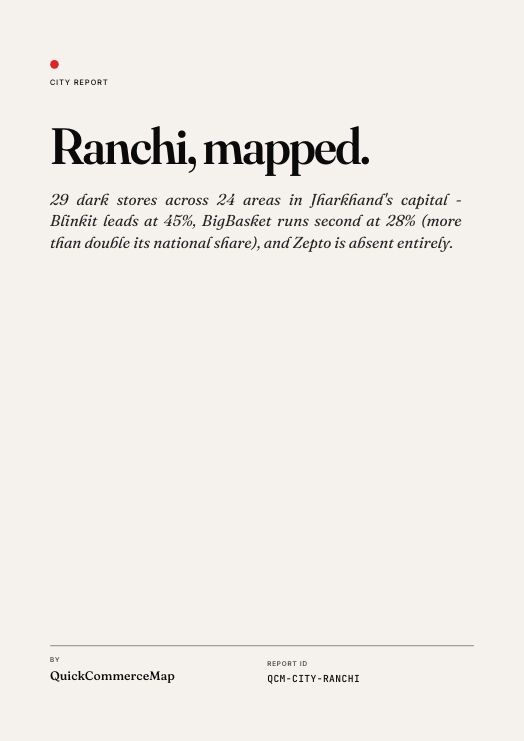
Our July 2026 data wave widens the lens considerably. QuickCommerceMap now tracks Blinkit, Zepto, Swiggy Instamart, Flipkart Minutes and BigBasket, adding Flipkart Minutes and BigBasket to the three we have followed since the project began, and the widened view rewrites Ranchi’s headline numbers. The city’s mapped network stands at 29 dark stores across 24 areas: Blinkit 13 (44.8%), BigBasket 8 (27.6%), Swiggy Instamart 4 (13.8%), and Flipkart Minutes 4 (13.8%). The two platforms we tracked here in earlier snapshots account for exactly the same 17 stores; the jump from 17 to 29 comes entirely from bringing Flipkart Minutes and BigBasket into view. Under the old three-platform lens, Blinkit looked like a 76% hegemon in an uncontested market. Seen whole, it holds a clear but more ordinary lead, with a Tata-owned challenger at nearly 28% that the earlier snapshots simply could not see.
What has not changed is the market’s defining absence: Zepto. The platform records no mapped store in Ranchi - or anywhere in our Jharkhand mapping, which also covers Jamshedpur and Dhanbad - even though it operates in 57 of 100 comparable cities in our dataset. Zepto’s city-launch pattern has concentrated on metros and western and southern tier-2 markets; its eastern-India footprint is thinner than Blinkit’s, and Jharkhand sits squarely in that thin zone. Whatever the reason, the practical consequence for Ranchi is that the discount-led promotional pull Zepto brings to contested markets has never operated here, and four of the five national platforms divide the city among themselves largely without overlapping.
Platform deep-dive
Blinkit is the incumbent and it looks like one. Its 13 stores (44.8% of the market, ten points above its 34.7% national share) spread across 12 of the 24 mapped areas - the widest coverage of any operator, at a deliberately thin 1.1 stores per area. Lalpur, with two Blinkit stores, is its only doubled-up position; single stores hold central Ranchi, Bariatu, Doranda, and a long tail of eight areas where Blinkit is the sole operator: Hindpiri, BIT, Namkum, Tongritoli, Harmu, Chauri, Lahkothi, and Morabadi. That list tells its own story - the BIT store serves the Mesra student corridor, Morabadi the maidan-adjacent institutional belt, Namkum the eastern periphery. This is the classic first-mover shape: claim every viable catchment early, hold most of them alone, and let brand recall compound.
BigBasket is the July mapping’s revelation. The Tata-owned grocer holds 8 stores (27.6%) across eight areas - more than double its 11.8% national share and nearly triple the roughly 10% it averages in peer cities, making Ranchi one of its strongest relative markets anywhere in our dataset. Six of its eight areas are exclusive territory: Kumhartoli, Jagarnathpur, Kanchnatoli, Hatma, Pahartoli, and Jai Prakash Nagar - predominantly the toli neighbourhoods and newer colonies the original platforms never entered. It contests the incumbents directly only in Lalpur and Doranda. For a platform with a scheduled-delivery heritage and a staples-heavy assortment, Ranchi’s salaried, first-of-the-month-budgeting households are close to an ideal demographic, and its siting suggests it knows it.
The remaining two operators split the last quarter of the market evenly. Swiggy Instamart’s 4 stores (13.8%, nearly five points under its 18.5% national average) sit in central Ranchi, Bariatu, Argora, and Kanka - the last two exclusively - a compact posture that leans on the parent app’s food-delivery familiarity in the city’s core. Flipkart Minutes, which launched nationally in 2024 on the back of Flipkart’s e-commerce logistics network, also holds 4 stores (13.8%, just under its 15.6% national share), and every one of them is a sole-operator position: Kathalkocha, Panchsheel Colony, Janiyar Nagar, and Gandhi Nagar. Four stores, four local monopolies - a pure periphery-colonisation play from an operator that can lean on an existing parcel backbone rather than fight for the contested core.
The sum is the most carved-up market in our peer set: 20 of the 24 mapped areas - 83% - have exactly one operator, and only Lalpur, central Ranchi, Bariatu, and Doranda offer residents a choice of two apps. For most of Ranchi, quick commerce means whichever platform got there first; the market’s next phase is defined by whether anyone - Zepto included - starts contesting someone else’s territory.
Underserved areas
HEC township at Dhurwa is a distinctive case. The PSU’s planned colonies - spread across roughly 20 square kilometres - house tens of thousands of residents in bungalow and flat blocks that have been in continuous occupation for over six decades. Our July 2026 mapping records no dark store within the township belt itself. The population is demographically addressable - salaried, middle-income, smartphone-capable - but the township’s internal geography is legacy-PSU: wide avenues, large plot sizes, and a consumption culture built around the HEC employee cooperative store and long-established kiranas. Operators who eventually crack HEC will need to work with the internal society structure rather than against it.
Ratu Road and the western expansion corridor toward Ratu and Tupudana represent a genuine growth opportunity. New residential developments, peripheral commercial activity, and a population mix heavy on young government-employee families would support two to four additional stores, yet the corridor shows no mapped store in the July data. Given that Flipkart Minutes and BigBasket have both demonstrated an appetite for exactly this kind of uncontested periphery elsewhere in the city, it is the most obvious next-entry target on the map.
The old-city commercial zone - Upper Bazaar and the Main Road mercantile heart - remains largely outside the network, though no longer entirely: Hindpiri now carries a single Blinkit store, the network’s one foothold at the old city’s edge. The zone is densely kirana-networked, with retail relationships that span generations and a population mix that includes older residents less inclined to app-based ordering, and the economics of delivery into narrow old-city lanes are adverse. One store here is a probe, not coverage.
Most importantly, tribal and peri-urban wards - Sonahatu Road, the settlements toward the Jonha Falls side, the tribal pockets within and around the municipal area - remain entirely outside quick commerce’s addressable market. This is not a gap that any operator is attempting to close, and the reasons are defensible: income levels, payment-method adoption, and consumption patterns do not match the model. But it is worth naming because it represents a significant share of the city’s nominal population.
Worker dimension
Ranchi’s 29 dark stores employ an estimated 232-435 workers across picker, packer, delivery, and store-management roles. At the industry’s 15-30% monthly attrition rates, that implies 35-131 new hires every month - roughly 420 to 1,570 a year - to hold current staffing. At tier-2 Jharkhand salary scales, entry-level pickers earn Rs 11,000-16,000 per month, store incharges Rs 16,000-22,000, store managers Rs 25,000-45,000, and delivery partners Rs 12,000-22,000. Ranchi’s labour market has two distinguishing features relative to comparable tier-2 cities.
First, literacy is high (87.68 percent, well above the national average) and English-language ability among younger workers is strong because of Ranchi’s unusually large educational-institution footprint. This gives operators a deeper pool of candidates for shift-incharge and store-manager roles than they typically find at this city tier. The downside is that the same pool has alternative options - IT/BPO roles, state-government clerical positions via competitive examination, bank recruitment - that often pay comparably or slightly better and offer more stability. Dark store roles compete for this workforce rather than being the default option.
Second, tribal population representation in the workforce is significant and distinctive. Workers from Munda, Oraon, and Ho communities - migrating from Gumla, Simdega, Khunti, and West Singhbhum - form a substantial share of entry-level hires. Cultural and linguistic accommodation (shift scheduling around local festivals, basic recognition of Mundari and Nagpuri speakers) affects retention in ways that operators from other regions do not always account for well. With four employers now running stores in the city instead of two, workers with even a few months of dark-store experience have meaningfully more switching power than they did a year ago.
Consumer dimension
The affordability index of 58 is moderate - slightly below the tier-2 median - but the composition of demand is more stable than that headline suggests. Government-salaried households and PSU-salaried households, whose combined share of the city’s middle-class population exceeds 40 percent by conservative estimates, provide a demand floor that is less volatile than private-sector-dominated cities of similar size. Paychecks arrive on the first of the month, households budget accordingly, and grocery expenditure is predictable. This is precisely the demand profile BigBasket’s staples-led assortment is built for, which goes some way to explaining why the Tata-owned platform has made Ranchi one of its strongest relative markets in the country.
The student segment is the second major driver. IIM Ranchi’s MBA cohort and BIT Mesra’s engineering base together represent thousands of non-local young adults with high app-ordering propensity - many come from tier-1 metros and bring that consumer behaviour with them. The mapping reflects the corridor’s value: Blinkit holds the BIT area outright, while Swiggy Instamart’s Kanka store works the Kanke Road stretch.
Where Ranchi’s consumer profile differs from most tier-2 cities is in the missing segment: there is still no Zepto-driven discount pull. Elsewhere, Zepto’s promotional pricing - steep first-order discounts, combo offers, student-targeted campaigns - is a primary mechanism that converts non-users into quick commerce buyers, and Ranchi’s market has grown entirely without it. The July numbers soften the old under-supply story: at 29 stores, the city now maps to roughly one store per 52,000 residents, close to par for its size, and 19 stores per million against a 3-per-million national average. But depth is not the same as choice. Twenty of 24 areas offer exactly one app, which means most Ranchi households face a single operator’s pricing and assortment with no practical alternative. The consumer story here is not scarcity of stores; it is scarcity of competition.
Industry context
Within Jharkhand, Ranchi has the state’s largest mapped quick commerce footprint. Jamshedpur records 24 stores in the July data and Dhanbad just 5; all are Blinkit-led with Zepto absent, and Ranchi’s density of 19.3 stores per million residents runs ahead of Jamshedpur’s 16.0. Against its similar-size peers nationally, Ranchi is mid-pack: Prayagraj maps 30 stores, Mysuru 31 (a Zepto-led market, in pointed contrast), and Vijayawada 31 against Ranchi’s 29.
The five-platform lens revises the market-structure story more than the scale story. The 76% Blinkit share that once made Ranchi a national outlier was an artifact of the narrower view; against the full field Blinkit holds 44.8% - still ten points above its national average, but no longer a hegemony. The genuine outlier finding now belongs to BigBasket: a 27.6% share against 11.8% nationally and roughly 10% in peer cities, built almost entirely in neighbourhoods - Kumhartoli, Hatma, Pahartoli, Jagarnathpur - that the original platforms never contested. Ranchi’s addressable market was wider than the incumbents’ siting implied, and it took the two platforms our earlier snapshots could not see to demonstrate it.
The growth trajectory still turns substantially on one question: does Zepto reverse its Jharkhand absence in the next 12-24 months? If it enters - even with a 3-5 store beachhead - the competitive dynamic shifts sharply: promotional marketing would pull new users into the category, and the incumbents would have to defend territory they currently hold uncontested. The second question is newer: whether Flipkart Minutes and BigBasket convert their periphery positions into direct competition with Blinkit’s core. Today only 4 of 24 areas see any head-to-head competition at all. A market this carved-up is stable right up until somebody decides it shouldn’t be.
Methodology
This report draws on the QuickCommerceMap July 2026 dataset of 5,625 dark stores across 408 Indian cities, compiled from publicly observable store-locator information published by Blinkit, Zepto, Swiggy Instamart, Flipkart Minutes, and BigBasket. Coverage of Flipkart Minutes and BigBasket begins with this July 2026 data wave, so comparisons with our earlier three-platform snapshots are noted explicitly where they appear. All store locations are approximate (to roughly 100 metres), and the dataset is a point-in-time snapshot - platform networks change week to week. For Ranchi, 29 stores were identified across 24 distinct areas; Zepto records no mapped store in the city or elsewhere in our Jharkhand coverage as of this data window.
Store coordinates were reverse-geocoded using a three-API fallback chain - Ola Maps (primary), Mappls (fallback), and Nominatim (last resort) - to derive locality names and area assignments. Demographic figures derive from Census of India 2011 projected to 2026 using WorldPopulationReview methodology. Economic context uses state-level NSDP with editorial adjustment for Ranchi-specific income, informed by IBEF’s Jharkhand state profile. PSU employment data draws on HEC, CCL, and MECON annual reports; educational-institution data derives from IIM Ranchi and BIT Mesra disclosures. Worker and hire estimates apply the standard QuickCommerceMap methodology of 8-15 workers per store and 15-30% monthly attrition, cross-referenced with QuickCommerceJobs salary data for tier-2 Jharkhand markets.
All indices (incomeIndex, smartphoneIndex, apartmentIndex, affordabilityIndex) are editorial judgements on a 0-100 scale, documented in the expansion enrichment panel. They are not derived from a single quantitative source but represent the research desk’s assessment informed by the sources listed.