City context
Rajahmundry - in its older and still widely used form, Rajamahendravaram - sits on the northern bank of the Godavari in east Andhra Pradesh, at the river’s fourth-to-last major settlement before it fans out into the delta and the Bay of Bengal. It is a city whose self-understanding is anchored more in cultural identity than in industrial output. Widely regarded as the cultural capital of Andhra Pradesh, it was the seat of medieval Andhra kingdoms and the city associated with Adikavi Nannaya - the eleventh-century poet who composed the first Telugu translation of the Mahabharata. The literary and linguistic heritage is not ornamental in Rajahmundry’s story; it is the frame through which the city’s middle-class residents understand themselves, and it shapes a consumer base whose discretionary spending leans toward books, festivals, cultural tourism, and premium-brand FMCG in a way that the pure port-industrial cities on this stretch of coast do not.
Underneath the cultural framing is a mature, stable industrial base. The ONGC Rajahmundry Asset anchors the administrative and technical operations for the Krishna-Godavari basin’s onshore and shallow-offshore gas fields, with the ITDA Colony housing a professional-class workforce whose incomes, apartment-style living, and consumption patterns are a distinct wedge of the city’s demographic. Andhra Paper (formerly Andhra Pradesh Paper Mills, operational since 1964) is one of India’s oldest integrated paper mills and remains a significant if declining employer. The Central Tobacco Research Institute has its main campus here, and the city’s role as East Godavari district headquarters produces substantial government-administration employment. Adikavi Nannaya University and Godavari Institute of Engineering and Technology (GIET) anchor the educational-institution demand base.
The 2026 urban-agglomeration estimate puts Rajahmundry at roughly 450,000 residents, with a sex ratio of 1,006 females per 1,000 males - above parity, a coastal-Andhra demographic signature. Growth is modest for a coastal-AP city, lower than Guntur or Nellore, reflecting the maturity rather than rapid expansion of the underlying economy. The city’s commercial geography runs from the dense old-city core of Danavaipeta and Aryapuram through the modern apartment corridors, with the ONGC concentration at ITDA Colony, the cultural-tourism riverfront from Gowthami Ghat to Havelock Bridge, and the eastern bank across the river remaining peripheral to delivery operations because of bridge-transit time constraints. The dark-store footprint the July 2026 data maps - seven stores across six residential colonies - sits squarely in the salaried-colony belt of this geography, and nowhere near the riverfront or the far bank.
Quick commerce story
Rajahmundry’s quick commerce timeline follows the coastal-AP small-city template. Blinkit entered first - our earlier tracking placed its arrival in the second half of 2024 - and Swiggy Instamart followed within a quarter or two, leveraging a food-delivery presence that had been active in the city since 2020-2021. Zepto has made no entry, then or since: zero of the city’s mapped stores, against a 19% national share and roughly 14% across peer cities. Fifty-seven of 100 comparable cities in our dataset have Zepto stores where Rajahmundry does not. The ONGC professional class is real but small, the cultural-capital wealth is diffuse rather than concentrated, and the paper-mill salaried cohort is stable but not growing - a base that matches broad-middle-class targeting, not Zepto’s premium-urban checklist.
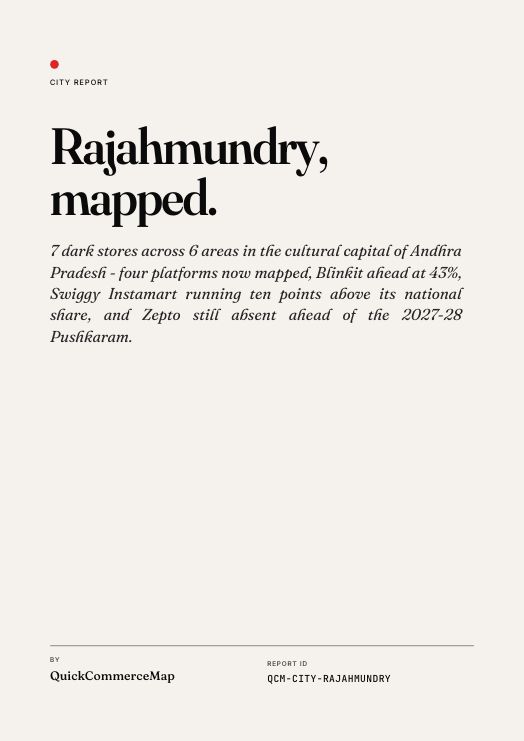
The July 2026 data wave changes what the market looks like. Our tracking now adds Flipkart Minutes and BigBasket to Blinkit, Zepto and Swiggy Instamart, which we have followed since the project began, and Rajahmundry turns out to be a four-operator town: 7 dark stores across 6 areas, split Blinkit 3 (42.9%), Swiggy Instamart 2 (28.6%), Flipkart Minutes 1 (14.3%), and BigBasket 1 (14.3%). The two platforms our March snapshot could see hold the same five stores they did then; the rise from 5 to 7 comes entirely from bringing the other two into view. The old 60/40 two-platform framing - which we ourselves used, and which paired Rajahmundry neatly with Kakinada - was an artifact of a narrower lens.
The footprint is small but proportionally dense: 16 stores per million residents against a 3-per-million national average. Every mapped store sits in a named residential colony - Prakasam Nagar, P And T Colony, Aditya Nagar, Navabharat Nagar, Gandhi Puram - rather than in the old-city bazaar or on the riverfront, which is exactly where the salaried, apartment-dwelling, app-capable households live. Prakasam Nagar, with a Blinkit and a Swiggy Instamart store, is the only area in the city with two stores and two operators; everywhere else, one platform serves the whole neighbourhood alone.
Platform deep-dive
Blinkit leads with 3 of the 7 mapped stores, a 42.9% share that runs about eight points above its 34.7% national footprint, spread across three areas: Prakasam Nagar, where it meets Swiggy Instamart head-on, and P And T Colony and Aditya Nagar, where it operates alone. Being first in and broadest is the Zomato-owned platform’s standard play in small southern markets, and holding two of the town’s five sole-operator areas gives it exactly the early brand-recall position that play is designed to buy.
Swiggy Instamart is the stronger-than-usual challenger. Its 2 stores translate to a 28.6% share - a full ten points above its 18.5% national average, making Rajahmundry one of Instamart’s relatively overweight markets. One store contests Prakasam Nagar; the other holds Navabharat Nagar as sole operator. The overweight makes strategic sense: Swiggy’s food-delivery operation has known this city’s ordering households since 2020-2021, and cross-selling groceries to an existing user base is cheaper than building one - precisely the kind of market where the parent app’s data lowers the cost of conviction.
The two platforms new to our tracking hold one store each, at 14.3% apiece. BigBasket, the Tata-owned grocer with a scheduled-delivery heritage, is sole operator in Gandhi Puram and sits slightly above its 11.8% national share. Flipkart Minutes - launched nationally in 2024 on the back of Flipkart’s e-commerce logistics network - is mapped to P&T Colony, a label that sits beside Blinkit’s P And T Colony assignment; two renderings of the same colony name in our clustering, which suggests the postal-colony belt is the one neighbourhood outside Prakasam Nagar where two operators work in close proximity. At 14.3%, Flipkart Minutes runs just under its 15.6% national share. Zepto remains the only national platform with no Rajahmundry presence at all.
What the mix means for residents is simple: five of the six mapped areas - 83% - have exactly one app that will deliver in ten minutes, and only Prakasam Nagar households can compare prices. Four operators have planted flags, but almost nobody in Rajahmundry has yet seen two of them compete; the market’s next phase begins when that changes.
Emerging expansion opportunity
Rajahmundry’s expansion opportunity breaks into four distinct segments, each with different operational and demographic characteristics.
The first is the southern apartment growth corridor around Morampudi and toward Aryapuram. This is the most active new-apartment zone in the city, with mid-rise projects and gated colonies absorbing demand from relocated government employees, returning Rajahmundry-origin professionals, and the broader AP middle-class upgrade cycle - and none of the seven mapped stores sits in it. A store sited here would serve an addressable population of 40,000 to 60,000 currently reached, if at all, on long delivery times from the existing colony stores.
The second opportunity is the ITDA Colony and ONGC professional-class belt. This is the highest-income residential concentration in the city and shows no dedicated mapped store. A dedicated ITDA-adjacent store would capture a consumer segment whose per-household order values are among the highest in Rajahmundry and whose ordering-frequency discipline is app-native. The unit economics are straightforward - compact service area, stable demand base, minimal delivery-radius waste.
The third opportunity is the Adikavi Nannaya University and GIET campus belts. Neither campus has the residential-student population density of SV University in Tirupati or JNTU Kakinada, but the combined faculty-plus-resident-student base and the adjacent professional-housing stock are commercially meaningful. A single store positioned to serve both campus corridors plus the southern apartment belt would be operationally efficient.
The fourth - and most commercially distinctive - is the Godavari Pushkaram opportunity. The next major Pushkaram festival is expected in 2027-2028, when an estimated 20 to 30 million pilgrims will transit Rajahmundry over a 12-day window. Current QC operations have never been tested against a Pushkaram-scale demand event, and the operational constraints (road-closure patterns, bridge-transit bottlenecks, riverfront-crowd dynamics) will reshape the delivery-economics calculus temporarily. Platforms that scale footprint before 2027 will capture both the baseline-demand expansion and the Pushkaram-event premium; platforms that wait will watch competitors establish positions under pressure. With four operators now holding ground instead of two, that pre-Pushkaram race has more entrants than our earlier analysis assumed.
Beyond Rajahmundry itself, the adjacent expansion thesis points to the Godavari delta towns - Kovvur across the river, Samarlakota 20 kilometres east, and Amalapuram 40 kilometres south-east. All have the commercial density and demographic profile that could support entry within 24 to 36 months as the coastal-AP network densifies.
Worker dimension
Rajahmundry’s seven dark stores employ an estimated 56 to 105 workers - pickers, packers, delivery partners, shift incharges, and store managers. At the industry’s 15-30% monthly attrition, that implies 8 to 32 new hires a month, 96 to 384 a year, to hold current staffing. At the city’s Tier D / Andhra Pradesh salary scale, entry-level pickers earn 11,000 to 16,000 rupees per month, store incharges 16,000 to 22,000, store managers 25,000 to 45,000, and delivery partners 12,000 to 22,000. These wages are priced against a Rajahmundry cost-of-living that is among the lowest of AP’s coastal cities. A shared room in Danavaipeta or the colony belts costs 2,500 to 4,000 rupees per month; a basic meal at a local mess runs 40 to 70 rupees. ITDA Colony rentals are higher but tied primarily to ONGC company-housing allotments rather than the retail rental market.
Labour supply in Rajahmundry has a distinctive pattern. The Godavari delta’s agricultural hinterland produces a steady inflow of young men seeking non-farm employment, and the alternatives - agricultural daily wage, tobacco-packing contract work, paper-mill contractor roles, coastal-fishing crew work - pay comparably to dark-store picker positions but without formal PF, ESI, or regular-hours structure. For a young Rajahmundry-origin worker or a migrant from the rural delta, a dark-store role is a straightforward upgrade. The willingness-to-transition is high.
Attrition at Rajahmundry is less acute than at most small-market cities. The proximity to Vizag (180 km north) and Vijayawada (180 km west) makes metropolitan transitions geographically feasible, but the wage differentials are not as large as the gaps that define north-Indian small-city attrition. The relative stability of the local employment base keeps picker-level churn at the lower end of the range, which is one reason the annual hiring requirement stays in the low hundreds rather than spiralling.
Consumer dimension
Rajahmundry’s affordability index of 51 places it in the Tier D middle band. The consumer profile is tri-modal, and the modal divisions are sharper and more spatially distinct here than at most small cities. At the top sit the ONGC professional class and a small but meaningful cohort of senior government officials, paper-mill senior staff, and cultural-establishment families - high-income, app-native, broad-category purchasers. In the middle sit the salaried professional households of the mapped colony belt - Prakasam Nagar, Aditya Nagar, Navabharat Nagar, Gandhi Puram - which is the operating QC market, and where every one of the city’s seven stores is sited. At the bottom, outside the addressable market, sit the old-city bazaar households, the agricultural-hinterland commuters, and the riverfront pilgrim-tourism ecosystem.
The segment that requires specific commentary is the cultural-capital commercial family base in Danavaipeta and Aryapuram. This is an established mercantile wealth segment whose members have been Rajahmundry residents for multiple generations, and whose consumption patterns have traditionally been anchored in specialist retailers (booksellers, textile merchants, cultural-goods shops) rather than modern retail channels. QC has captured a rising share of their FMCG and personal-care spending but does not yet compete with specialist shops on the cultural-goods categories that matter most to this segment. The category mix at Rajahmundry is therefore narrower than at port-industrial cities of comparable size.
Choice, meanwhile, remains the market’s binding constraint. Only Prakasam Nagar residents can toggle between two apps - Blinkit and Swiggy Instamart - and let competition work on price and delivery time; the other five mapped areas each depend on a single operator, whether that is Blinkit in Aditya Nagar, Swiggy Instamart in Navabharat Nagar, or BigBasket in Gandhi Puram. Order patterns skew toward evening windows, with festival peaks compounding materially at Ugadi, Sankranti, Dussehra, and Deepavali. The next Godavari Pushkaram, expected 2027-2028, will create an unprecedented 12-day commercial demand spike whose impact on local QC operations has no comparable historical reference - a natural experiment in how small-city dark-store networks handle pilgrim-festival demand at scale.
Industry context
Among Andhra Pradesh’s coastal small cities, Rajahmundry occupies a specific position as the cultural-capital counterpart to the port-industrial Kakinada. The pairing survives the July 2026 remapping, though it is no longer the mirror image our earlier snapshots showed: Kakinada now records 8 mapped stores to Rajahmundry’s 7, and Tirupati - the state’s temple-economy comparator - also stands at 8. Within the similar-tier set nationally, Bhilai and Belagavi match Rajahmundry at 7 stores each. The most instructive contrast is Hubballi, also at 7 stores but led by Zepto - proof that at this market size the platform mix is a strategic choice, not a structural inevitability, and that Rajahmundry’s Zepto absence is a decision about this market rather than about markets this size.
That absence remains among the most consistent patterns in our coastal-AP coverage, extending across Kakinada, Nellore, Ongole, and Kurnool in our observed data, with Guntur the notable exception in earlier analysis. Zepto’s filtering of markets against its premium-urban demographic checklist is the simplest explanation, and nothing in Rajahmundry’s July numbers - a diffuse middle-class base, an 83% single-operator map, sub-1,000-rupee-basket economics - argues for the checklist changing soon.
What has changed is the shape of the field Zepto would enter. Judged by the old two-platform lens, Rajahmundry was a stable Blinkit-Swiggy duopoly; seen whole, it is a four-operator market in which the Tata- and Flipkart-backed national networks each hold a colony, and in which Swiggy Instamart is running ten points hot against its national share. The growth trajectory from here depends on four factors: whether the Morampudi-Aryapuram apartment completions accelerate through 2026-2027; whether ONGC KG-basin activity expands materially; whether the 2027-2028 Pushkaram triggers pre-emptive footprint expansion; and whether any of the four incumbents converts coexistence into competition by opening a second store in someone else’s colony. A market of 7 stores across 6 areas has plenty of map left - the question is who moves before the festival clock forces everyone’s hand.
Methodology
This report draws on the QuickCommerceMap July 2026 dataset of 5,625 dark stores across 408 Indian cities, compiled from publicly observable store-locator information published by Blinkit, Zepto, Swiggy Instamart, Flipkart Minutes, and BigBasket. Coverage of Flipkart Minutes and BigBasket begins with this July 2026 data wave, so comparisons with our earlier three-platform snapshots are noted explicitly where they appear. All store locations are approximate (to roughly 100 metres), and the dataset is a point-in-time snapshot - platform networks change week to week. For Rajahmundry, 7 stores were identified across 6 distinct areas; Zepto’s absence reflects our observed data as of this window.
Store coordinates were reverse-geocoded using a three-API fallback chain - Ola Maps (primary), Mappls (secondary), and Nominatim (tertiary) - to obtain localities and area assignments. Demographic data derives from Census of India 2011, projected to 2026 using WorldPopulationReview methodology. Economic context uses MoSPI state-level Andhra Pradesh NSDP figures, as city-level GDP data is not publicly available for Rajahmundry. Industry data draws on ONGC’s Rajahmundry Asset operational disclosures, Andhra Paper’s publicly filed annual reports, and the Central Tobacco Research Institute’s public documents. Cultural and tourism context uses AP Tourism Department materials and Rajahmundry Municipal Corporation disclosures; Godavari Pushkaram cycle references draw on AP state government Pushkaram planning documentation.
Worker and hire estimates apply the standard QuickCommerceMap methodology: 8-15 workers per store, 15-30% monthly attrition, cross-referenced with QuickCommerceJobs salary data for Tier D Andhra Pradesh markets. All indices (affordabilityIndex and related editorial judgements) are editorial judgements on a 0-100 scale, documented in the expansion enrichment panel. They are not derived from a single quantitative source but represent the research desk’s assessment informed by the sources listed above and by structural comparison with other coastal-AP small cities (Kakinada, Tirupati) and similar-tier markets nationally (Hubballi, Belagavi, Bhilai).