City context
Raipur is a city that has fundamentally changed character in the last quarter century. Before November 2000 it was the largest urban centre of eastern Madhya Pradesh - significant but not distinctive, one of several mid-sized commercial cities in the Hindi belt. Then Chhattisgarh was carved out of Madhya Pradesh as India’s 26th state, Raipur was designated the capital, and the city’s economic and administrative trajectory bent upward. Government offices moved in. The Legislative Assembly was constituted. The state-level directorates, regional offices of central agencies, and the administrative apparatus that comes with statehood required housing, services, and supporting infrastructure. Raipur’s Census 2011 population of 1.01 million reflected the first decade of this transformation; the 2026 estimate of 1.3 million reflects the second.
The city sits at roughly 300 metres elevation on the Chhattisgarh plains, connected by rail and the Swami Vivekananda Airport to Delhi, Mumbai, Bangalore, Hyderabad, and Kolkata. It is surrounded by one of India’s densest steel and mineral-processing clusters: Bhilai Steel Plant (SAIL) is 25 kilometres west in Durg, and the extended catchment includes Jindal Steel and Power’s operations at Raigarh, NMDC’s iron-ore mining, and SECL’s coal operations. Raipur itself does not host much heavy industry - the city proper is administrative, commercial, and increasingly professional-services oriented - but it functions as the white-collar headquarters for the surrounding industrial economy. Steel-company executives, mining-company consultants, power-sector professionals, and the auditors, lawyers, and bankers who serve them all concentrate in Raipur’s Civil Lines, Shankar Nagar, and Samta Colony belts.
The second transformation is still in progress: Naya Raipur (officially Atal Nagar, renamed in 2018), a planned smart city 20 kilometres south of Raipur proper, designed as the future Chhattisgarh capital. Substantial government infrastructure has already relocated - Mantralaya buildings, the High Court wing, police headquarters, and state-department offices - but residential build-out lags. The new city’s population remains small, and much of the working administrative population commutes from Raipur proper daily. Over the next decade, Naya Raipur is expected to become the primary residential destination for government employees and the emerging IT-sector workforce; for now it is a significant urban-development project whose influence on the city’s economy is measurable but not yet dominant.
The 2026 population of 1.3 million reflects sustained growth, high literacy (86.9 percent, among the highest in Chhattisgarh), and a balanced sex ratio (945 females per 1,000 males, above national average) that reflects the state’s traditionally equitable demographic patterns. IIM Raipur, NIT Raipur, and AIIMS Raipur - all established post-statehood as part of central government investment in new-state capitals - collectively bring roughly 3,500 students plus significant faculty and resident-doctor populations, whose demographic profile (non-local, urban-origin, app-native) provides a distinctive demand anchor.
Quick commerce story
Blinkit arrived first - our earlier tracking placed its entry in early 2024 - with its opening stores in the Shankar Nagar and Civil Lines belt, the administrative and professional core of the city. Raipur was among Blinkit’s priority central-India entries because the state-capital demographic offered the kind of stable salaried base that translates into predictable quick commerce demand. Swiggy Instamart followed later that year, leveraging Swiggy’s food-delivery presence in the city since roughly 2020, but with a thinner commitment: the company’s warehouse and distribution infrastructure in central India is less built-out than its eastern or southern presence, which makes tier-2 Chhattisgarh entry more logistically demanding.
Zepto did not enter, and as of July 2026 it still has not. Zepto’s complete absence from Raipur - zero of the city’s 22 mapped stores, against a 19.4% national share and roughly 14% across peer cities - is consistent with its broader central-India skip. The company’s city-launch priorities have concentrated on western and southern tier-2 markets, and 57 of 100 comparable cities in our dataset have Zepto stores where Raipur does not. The market has developed entirely without Zepto, and that absence remains a defining feature of the platform mix.
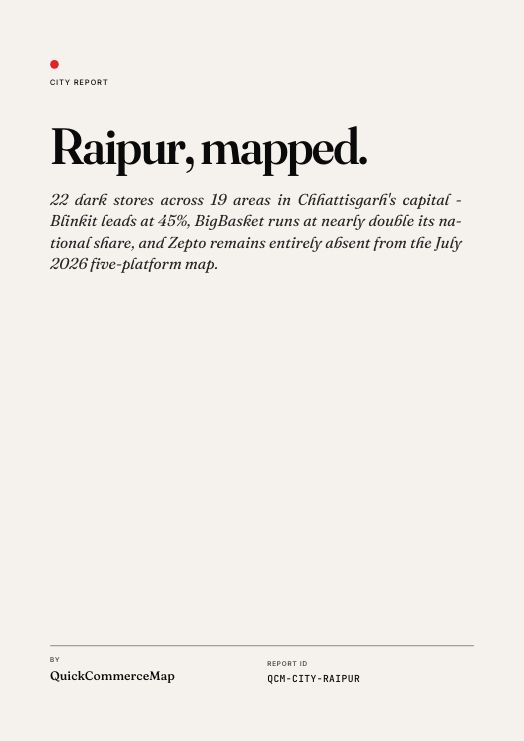
The July 2026 data wave widens the lens considerably. Our tracking now adds Flipkart Minutes and BigBasket to Blinkit, Zepto and Swiggy Instamart, which we have followed since the project began, and the widened view changes Raipur’s picture materially. The city’s mapped network stands at 22 dark stores across 19 areas: Blinkit 10 (45.5%), BigBasket 5 (22.7%), Swiggy Instamart 4 (18.2%), and Flipkart Minutes 3 (13.6%). The two platforms our March 2026 snapshot could see account for exactly the same 14 stores they did then; the headline rise from 14 to 22 comes entirely from bringing BigBasket and Flipkart Minutes into view. Raipur, it turns out, was never really a two-platform market - our earlier snapshots simply could not see the rest of it. Under the old lens Blinkit looked like a 71% hegemon; against the full four-operator field it holds a still-commanding but more contestable 45.5%.
The geography is the other striking feature. Twenty-two stores across 19 distinct areas works out to barely 1.2 stores per neighbourhood - a land-grab pattern in which every operator has prioritised planting flags over building depth. Only two areas hold more than a single store: the central Raipur cluster, with three stores, and Mowa on the northern arterial, with two. Everywhere else - from Pandri and Shankar Nagar through Gudhiyari and Santoshi Nagar - one store serves the whole catchment, and one platform owns it.
Platform deep-dive
Blinkit leads with 10 of the city’s 22 stores, a 45.5% share that runs nearly eleven points above its 34.7% national footprint, spread across 9 of the 19 mapped areas - the widest coverage of any operator. Its two-store anchor sits in the central Raipur cluster, with single stores fanning out through the middle-class residential belt. Seven areas are Blinkit-exclusive - Pandri, Shankar Nagar, Samta Colony, VIP Colony, Civil Lines, Lalpur, and Bhatagaon - which amounts to the entire administrative and professional core of the city being a one-app territory. This is the Zomato-owned platform’s standard tier-2 playbook: enter first, spread wide, and let brand recall compound before anyone else arrives.
The genuine surprise of the July mapping is BigBasket in second place. The Tata-owned grocer holds 5 stores (22.7%) across five areas - nearly double its 11.8% national share, making Raipur one of its strongest relative markets anywhere in our dataset. It is sole operator in Shatabdi Nagar, Vishrampuri, Fafadih, and Kota, and it contests Mowa alongside Blinkit - the only area in the city where the two largest operators meet. For a platform whose heritage is scheduled slot-delivery grocery rather than ten-minute convenience, that footprint reads as a deliberate bet on Raipur’s staples-heavy, family-household basket - the government-employee and trader demographics here order rice, atta, and oil, not late-night snacks.
Swiggy Instamart’s 4 stores (18.2%) sit almost exactly on its 18.5% national average - neither over- nor under-weighted, a rarity in our dataset. Its shape, though, is distinctive: one store in the central cluster and three sole-operator positions in Mahaveer Nagar, Mahamai Para, and Amanaka, the last anchored by the NIT Raipur catchment on the city’s western side. Flipkart Minutes holds 3 stores (13.6%), two points under its 15.6% national share, and all three are sole-operator plays in areas nobody else has touched: Changorabhata, Santoshi Nagar, and Gudhiyari - dense, older, working-class and lower-middle-class wards south and west of the commercial core. As industry context, Flipkart launched the Minutes service in 2024 on the back of its national e-commerce logistics network, and colonising the periphery the incumbents skipped is exactly what an operator with an existing parcel backbone can afford to try. Zepto, as noted, is absent entirely - the only one of the five national platforms with no Raipur presence.
The sum is a market of territorial claims rather than contests. Seventeen of the 19 mapped areas - 89% - have exactly one operator, among the highest exclusivity rates in our coverage, and only residents of central Raipur and Mowa can compare prices across apps. For everyone else, quick commerce in Raipur means whichever platform got to their neighbourhood first; the market’s next phase begins when someone opens a second store in someone else’s area.
Underserved areas
Naya Raipur is the most interesting underserved zone, and its status is paradoxical. It is the planned-city showcase of Chhattisgarh, deliberately designed with wide roads, apartment-ready zoning, and modern-infrastructure provisions - the exact conditions quick commerce operators optimise for. But current residential density is low, the daytime office population commutes in from Raipur proper, and weekend traffic is thin. None of the 19 mapped areas in the July 2026 data sits in Naya Raipur. Over the next three to five years, as Chhattisgarh Housing Board projects and private developers complete residential phases, Naya Raipur could plausibly support five to ten dark stores on its own. For now, its underserved status reflects growth potential rather than market failure.
The old-city bazaar wards - Gol Bazar, Purani Basti, Chandni Chowk - are the second underserved zone, though the picture at their perimeter has changed. These are traditional commercial districts with dense Marwari-trader community retail relationships that span generations; kirana networks here operate on informal credit, multi-generational trust, and retail relationships integrated with wedding-season wholesale and festival-period bulk purchases. Quick commerce cannot displace this economically, and the innermost wards remain unmapped. But the edges are being probed: Fafadih, by the railway station, now carries a BigBasket store, and Gudhiyari, the dense ward west of the core, carries a Flipkart Minutes - in both cases the newly tracked platforms testing territory the original entrants never contested.
The western Bhilai-corridor belt - heading toward Durg and Bhilai proper - represents a peri-urban expansion zone where residential development is growing but has not yet reached critical density within Raipur’s own map. Bhilai itself now records 7 mapped stores in our dataset, so the corridor’s endpoints are covered even as the stretch between them remains thin.
The tribal and forested-outskirt populations, especially toward the Dhamtari direction and the Barnawapara forest fringe, are outside the addressable market. Tribal-catchment residential areas have low app adoption and consumption patterns that quick commerce cannot serve profitably.
Worker dimension
Raipur’s 22 dark stores employ an estimated 176-330 workers across picker, packer, delivery, and store-management roles. At the industry’s 15-30% monthly attrition, that means 26-99 new hires every month - 312 to 1,188 a year - to hold current staffing. At tier-2 Chhattisgarh salary scales, entry-level pickers earn Rs 11,000-16,000 per month, store incharges Rs 16,000-22,000, and store managers Rs 25,000-45,000, with delivery partners in the Rs 12,000-22,000 band. Raipur’s labour market has two distinctive features.
First, literacy (86.9 percent) is unusually high for a central Indian tier-2 city, and English-language capability among younger workers is stronger than in comparable Hindi-belt cities. IIM Raipur, NIT Raipur, and AIIMS Raipur have raised the regional benchmark for education and language. This gives operators a deeper shift-incharge and store-manager pool than they typically find at this tier, though the competition from government-sector recruitment (Chhattisgarh PSC, SSC, central government recruitment through regional offices) is substantial - the same youth cohort that qualifies for dark-store supervisory roles is also actively preparing for government exams, and retention is therefore harder than wages alone would suggest.
Second, the labour pool draws from a linguistically distinct region. Hindi dominates but Chhattisgarhi (the regional language, recognised as one of Chhattisgarh’s official languages) is the first language for a significant share of workers. Customer-facing interactions routinely code-switch between Hindi and Chhattisgarhi. Operators who accommodate this linguistic diversity (including Chhattisgarhi-capable customer-service training) see better customer satisfaction, though the difference is subtle.
Consumer dimension
The affordability index of 60 is close to the tier-2 median. Government-employee households in Shankar Nagar, Civil Lines, and Samta Colony provide the addressable market’s foundation - salaried, apartment-dense, app-capable, and with predictable monthly grocery budgets. Bhilai Steel Plant and power-sector ancillary professional families add a second stable-income layer. All three of those core colonies, notably, are Blinkit-exclusive territory in the July mapping: the households best suited to quick commerce have exactly one app that serves them.
The student and young-professional segment - concentrated around IIM Raipur and NIT Raipur and AIIMS Raipur at Tatibandh - is the third driver. IIM Raipur’s MBA cohort in particular brings high app-ordering propensity, reflecting their home-city consumption patterns. The Amanaka store on the western side, Swiggy Instamart’s sole-operator position nearest the NIT catchment, is the clearest siting decision aimed at this cohort. AIIMS resident doctors and faculty represent a less visible but economically significant segment with consistent app usage.
The Naya Raipur early-residential cohort - small but growing, comprising IT-sector professionals and government employees who have relocated to the new city - represents the fastest-growing demand segment, though it remains beyond the current store map. The rice-trade merchant community, the Marwari-trader commercial class, and the small-business owners of the old commercial city are economically capable but culturally distinct: household consumption is high but flows through established provision-store relationships rather than through apps. Category penetration here will require generational turnover more than marketing investment.
The absence of Zepto-led competitive pricing pressure remains visible in Raipur’s adoption curve. Elsewhere, Zepto’s aggressive student- and young-professional-targeted discount campaigns convert non-users into active quick commerce users at a pace that incumbent-led markets cannot replicate. Raipur’s market has grown organically without this pull - and with 17 of 19 areas served by a single platform, most residents have never seen two apps compete for their basket at all. Overall category penetration is meaningfully lower than population and income metrics alone would predict.
Industry context
Within Chhattisgarh, Raipur is the state’s largest quick commerce market by a substantial margin: its 22 mapped stores compare with 7 in Bhilai, the state’s second market, despite broadly similar demographics across the Raipur-Durg-Bhilai belt. At 17 stores per million residents, Raipur also sits far above the 3-per-million national average - a density figure that says less about saturation than about how thinly quick commerce has spread across India’s 409 covered cities.
The similar-size peer set frames the market soberly. Ranchi - the closest structural comparison, another new-state capital with a tribal hinterland and a mineral-economy professional class - records 29 stores, seven more than Raipur. Jamshedpur holds 24, Meerut and Jalandhar 20 each. Raipur is mid-pack: ahead of the Punjab and western-UP peers on density, behind the eastern new-capital markets where quick commerce arrived on a similar timeline. The five-platform lens also revises the market-structure story: judged only by Blinkit and Swiggy Instamart, Raipur looked like a lopsided duopoly stuck at 14 stores; seen whole, it is a four-operator market in which BigBasket - invisible in our earlier snapshots - is the second-largest player, and in which the two newest-tracked operators hold seven sole-operator areas between them.
The growth trajectory depends on three interlinked factors. Does Naya Raipur’s residential build-out accelerate in the next 18-24 months? If yes, the planned city becomes the most obvious greenfield for every operator at once. Does Zepto reverse its Chhattisgarh skip? Unlikely near-term, but Raipur would presumably be among its first entries if the central-India strategy changes, and a fifth operator entering a market where 89% of areas are uncontested would shift the dynamic sharply. And does anyone convert territorial coexistence into competition - a second store in a rival’s area - before the map fills out? The 22-store, 19-area shape suggests the land-grab phase is still running; the market’s character will be set by whichever question resolves first.
Methodology
This report draws on the QuickCommerceMap July 2026 dataset of 5,625 dark stores across 408 Indian cities, compiled from publicly observable store-locator information published by Blinkit, Zepto, Swiggy Instamart, Flipkart Minutes, and BigBasket. Coverage of Flipkart Minutes and BigBasket begins with this July 2026 data wave, so comparisons with our earlier snapshots are noted explicitly where they appear. All store locations are approximate (to roughly 100 metres), and the dataset is a point-in-time snapshot - platform networks change week to week. For Raipur, 22 stores were identified across 19 distinct areas; Zepto’s absence reflects our observed data as of this window.
Store coordinates were reverse-geocoded using a three-API fallback chain - Ola Maps (primary), Mappls (secondary), and Nominatim (tertiary) - to derive locality names and area assignments. Demographic figures derive from Census of India 2011 projected to 2026 using WorldPopulationReview methodology. Economic context uses MoSPI Chhattisgarh NSDP and IBEF state profile for state-level figures, CSIDC industrial mapping for sector mix, and Naya Raipur Development Authority disclosures for the planned-city context. Educational institution data draws on IIM Raipur, NIT Raipur, and AIIMS Raipur public disclosures.
Worker and hire estimates apply the standard QuickCommerceMap methodology: 8-15 workers per store, 15-30% monthly attrition, cross-referenced with QuickCommerceJobs salary data for tier-2 Chhattisgarh markets. All indices (incomeIndex, smartphoneIndex, apartmentIndex, affordabilityIndex) are editorial judgements on a 0-100 scale, documented in the expansion enrichment panel. They are not derived from a single quantitative source but represent the research desk’s assessment informed by the sources listed.